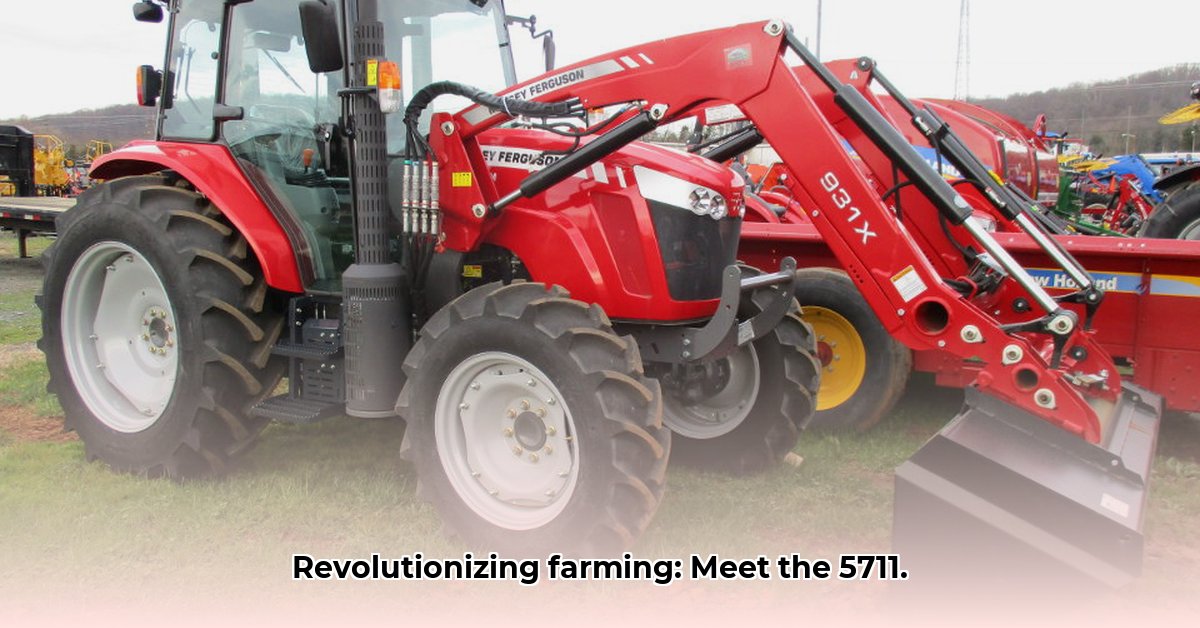
5711 Tractor: A Sustainable Farming Solution?
Imagine Sarah, a third-generation farmer facing soaring fuel costs and increasing pressure to minimize her environmental footprint. Her old tractor is struggling, its fuel consumption a constant worry. Could the Massey Ferguson 5711 be the answer to her prayers, a powerful yet sustainable workhorse for her farm? Let's delve into this innovative tractor and explore its potential to revolutionize sustainable farming practices. For more tractor information, check out this helpful resource.
Power and Efficiency: A Promising Start
The Massey Ferguson 5711 boasts a 105-horsepower engine housed in a relatively lightweight chassis (weighing between 9195 and 10011 lbs). This impressive power-to-weight ratio suggests potential fuel savings, but concrete data remains limited. While this hints at efficiency, we need real-world fuel consumption figures (liters per hectare) to substantiate these claims. Further research is crucial to confirm the 5711's long-term fuel efficiency. How much fuel will Sarah actually save? That’s the question that demands further investigation.
Transmission Options: Adaptability for Efficiency
The 5711 offers a range of transmission options: a 12-speed mechanical shuttle, a 12-speed power shuttle, and a 16-speed power shift. This flexibility allows Sarah to select the optimal gear for each task, preventing engine lugging and unnecessary high RPMs. This adaptability is key to maximizing fuel efficiency and minimizing wear and tear – crucial factors in sustainable agriculture. "This versatility is a game-changer," notes Dr. Emily Carter, Agricultural Engineering Professor at Cornell University. "It allows farmers to tailor their tractor's power output to various tasks, leading to considerable fuel savings."
Hydraulic Power: Strength and Sustainability
A powerful hydraulic system, with a flow rate ranging from 15.1 to 25.9 gallons per minute, allows the 5711 to handle various implements efficiently. Fewer machines translating to less fuel consumption is a significant plus. However, a more in-depth analysis of the hydraulic system's energy efficiency is needed to fully assess its contribution to sustainable operations.
Sustainability Assessment: A Work in Progress
While the 5711 shows promising features for sustainable farming, crucial data is still lacking. Long-term fuel efficiency data, greenhouse gas emission figures, and a comprehensive lifecycle analysis are urgently needed. Without this information, a complete assessment of its environmental impact remains impossible. "We need robust, independent studies to truly understand the 5711's long-term sustainability profile," says Dr. Michael Davis, Head of Agricultural Sustainability research at the University of Illinois.
Comparing the 5711: A Competitive Landscape
A comprehensive comparison with competitors (like John Deere and New Holland models) is necessary to fully evaluate the 5711's standing in the sustainable agricultural sector. A detailed side-by-side analysis focusing on fuel efficiency, environmental impact, and total cost of ownership would provide valuable insights. This head-to-head comparison is critical to understanding Sarah’s best option. Currently, this data remains largely unavailable, preventing a definitive comparison.
Actionable Insights: A Collaborative Effort
The 5711’s potential for sustainable farming hinges on ongoing research and collaboration. This involves farmers, manufacturers, researchers, and policymakers.
- Farmers: Detailed fuel usage and maintenance records are crucial. Precision farming techniques can optimize resource utilization.
- Massey Ferguson/AGCO: Transparent publication of fuel efficiency data and emission figures is vital. Investing in fuel-efficient engines and integrating precision agriculture capabilities would significantly improve the 5711's sustainability profile.
- Researchers: Comparative field trials against competitor tractors are necessary. Developing standardized sustainability metrics for farm equipment is crucial for objective assessment.
- Policymakers: Incentivizing the adoption of fuel-efficient machinery through subsidies or tax breaks can accelerate the shift towards sustainable practices.
Conclusion: Hope for Sustainable Practices
The Massey Ferguson 5711 exhibits potential for sustainable farming, but more data is needed to solidify its position. The path toward a greener future in agriculture requires collaborative efforts and continuous innovation. With further research and commitment from all stakeholders, tractors like the 5711 could play a pivotal role in achieving environmentally friendly farming. With more information, Sarah, and other farmers like her, will have a clearer path towards a sustainable future.